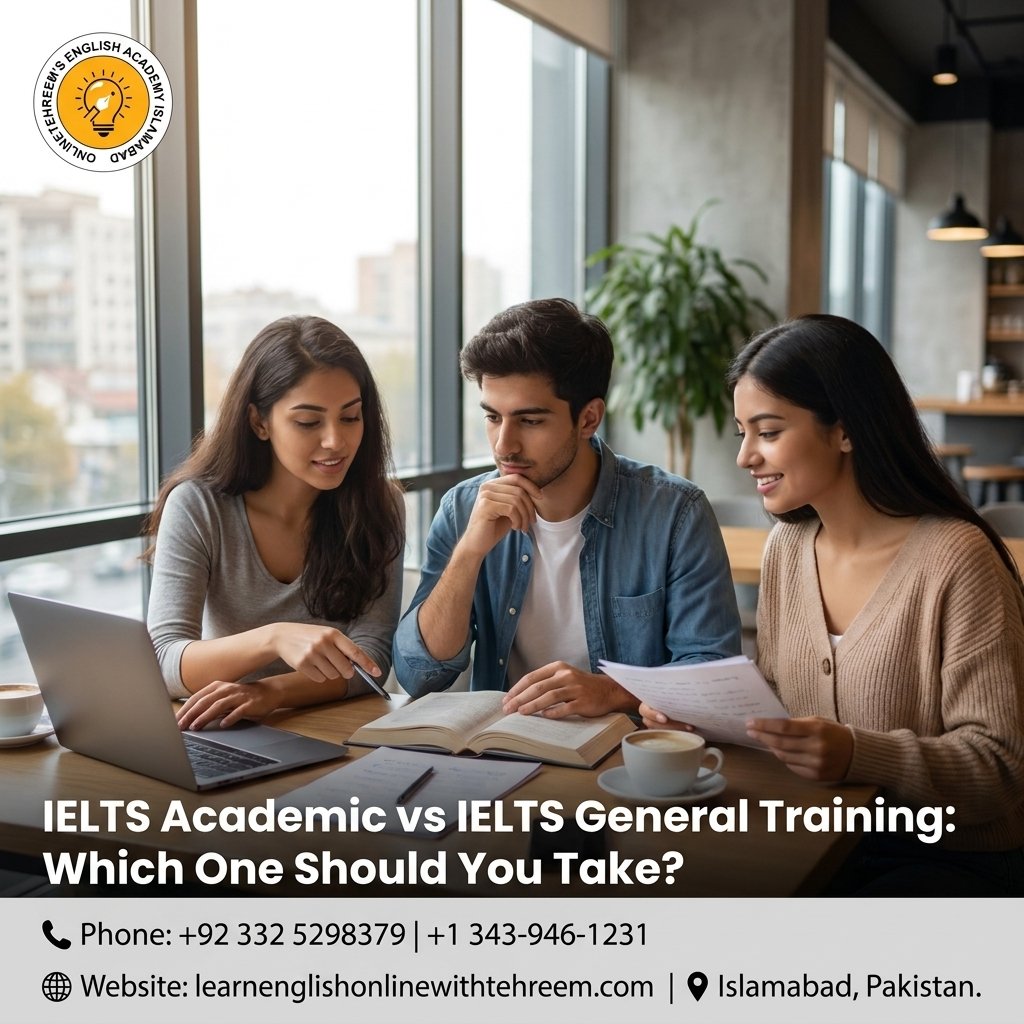
IELTS Academic vs IELTS General Training: discover the key differences in purpose, Reading, Writing, scoring, and preparation to choose the right IELTS test.
Choosing the right IELTS test is one of the most important decisions you’ll make before starting your preparation. Many students and professionals get confused about IELTS Academic vs IELTS General Training because both tests assess Listening, Reading, Writing, and Speaking.
So, which one should you take?
The answer depends mainly on why you need IELTS. If you’re planning to study at a university or pursue certain professional registration pathways, IELTS Academic may be the right option. If you’re preparing for migration, work, or other non-academic purposes, IELTS General Training may be more suitable.
Let’s explore the differences so you can make a confident decision.
IELTS Academic vs IELTS General Training: Quick Comparison
| Feature | IELTS Academic | IELTS General Training |
|---|---|---|
| Main purpose | Higher education and certain professional registration | Migration, work, and practical purposes |
| Listening | Same | Same |
| Speaking | Same | Same |
| Reading | Academic texts | Everyday and workplace-related texts |
| Writing Task 1 | Graph, chart, table, diagram, map, or process | Letter |
| Writing Task 2 | Essay | Essay |
| Difficulty | Academic language and texts can be demanding | More practical language and situations |
| Best for | University applicants and some professionals | Many migration and work applicants |
The most important difference is in the Reading and Writing sections. Listening and Speaking follow the same basic format in both versions.
What Is IELTS Academic?
IELTS Academic is designed for people who need to demonstrate English proficiency for academic study or certain professional purposes.
If you’re planning to study at a university, college, or another higher education institution where IELTS is required, you will often need the Academic version.
Who Should Take IELTS Academic?
IELTS Academic may be appropriate if you are:
- Applying for an undergraduate degree
- Applying for a master’s programme
- Applying for a PhD or research programme
- Planning to study at an English-medium institution
- Applying for certain professional registration pathways
- Meeting an academic English requirement
For example, a Pakistani student applying for a master’s programme abroad may be asked to submit an IELTS Academic score.
However, requirements vary. Always check the specific requirements of your university, programme, or professional body before booking your test.
What Does IELTS Academic Test?
The Academic version evaluates whether you can understand and communicate in English in situations relevant to higher education.
You may encounter academic-style:
- Articles
- Descriptions
- Arguments
- Reports
- Graphs
- Tables
- Diagrams
- Processes
You don’t need to be an expert in the subject matter. The test is primarily assessing your ability to understand and use English.
What Is IELTS General Training?
IELTS General Training focuses more on English used in everyday, social, and workplace environments.
It is commonly used for migration and some employment or training-related purposes.
Who Should Take IELTS General Training?
You may need General Training if you’re:
- Applying for a migration pathway
- Moving to an English-speaking country for work
- Applying for certain employment-related requirements
- Undertaking practical or non-academic training
- Meeting a specific requirement that accepts General Training
The exact test requirement depends on your destination, visa category, employer, or organization.
What Does IELTS General Training Test?
General Training Reading and Writing are more closely connected with practical communication.
You may need to understand:
- Advertisements
- Notices
- Instructions
- Workplace information
- Everyday correspondence
- General-interest texts
The test still requires strong English skills. “General” doesn’t mean “no preparation needed”—unfortunately, IELTS hasn’t introduced the magical easy version yet!
IELTS Academic vs IELTS General Training: Reading Differences

Reading is one of the biggest differences between the two tests.
IELTS Academic Reading
Academic Reading contains texts that are more suitable for an educational or academic context.
Questions can test your ability to:
- Identify the main idea
- Locate specific information
- Understand opinions
- Identify the writer’s claims
- Recognize relationships between ideas
- Understand vocabulary from context
- Summarize information
The texts can contain complex sentence structures and less familiar vocabulary.
IELTS General Training Reading
General Training Reading focuses more on practical and everyday material.
You may encounter texts related to:
- Public information
- Workplace situations
- Advertisements
- Services
- Notices
- General topics
You’ll still need skills such as skimming, scanning, identifying keywords, and understanding paraphrasing.
Which Reading Test Is Easier?
It depends on your strengths.
Someone who regularly reads academic material may find Academic Reading comfortable. Someone who is more familiar with everyday English may prefer General Training.
Don’t choose your test simply because you think one is easier. Your purpose should determine your test type.
IELTS Academic vs IELTS General Training: Writing Differences
Writing is another major area where the tests differ.
IELTS Academic Writing Task 1
In Academic Writing Task 1, you generally need to describe, summarize, or explain visual information.
This may include:
- Line graphs
- Bar charts
- Pie charts
- Tables
- Maps
- Processes
- Diagrams
You’ll need to identify important information and present it in a clear, organized way.
IELTS General Training Writing Task 1
General Training Writing Task 1 involves writing a letter.
Depending on the situation, the letter can be formal, semi-formal, or informal.
For example, you may need to write to someone about:
- A problem
- A request
- An arrangement
- An explanation
- A recommendation
- A personal or practical situation
Understanding tone is particularly important.
Writing Task 2
Writing Task 2 in both versions requires an essay response.
You’ll need to:
- Understand the question
- Develop relevant ideas
- Organize paragraphs logically
- Support your arguments
- Use appropriate vocabulary
- Demonstrate grammatical control
Task 2 carries significant weight, so it deserves serious preparation regardless of which IELTS version you’re taking.
Are IELTS Listening and Speaking the Same?
Yes, the Listening and Speaking components are essentially the same for Academic and General Training candidates.
Listening
You’ll listen to recordings involving different situations and answer questions based on what you hear.
Good preparation should focus on:
- Listening for specific information
- Understanding different accents
- Predicting answers
- Following conversations
- Recognizing paraphrasing
- Maintaining concentration
Speaking
The Speaking test is also conducted through the same general format.
You’ll discuss familiar topics, speak for a longer turn, and answer discussion questions.
The examiner considers areas including:
- Fluency and coherence
- Lexical resource
- Grammatical range and accuracy
- Pronunciation
This means your speaking preparation can focus on developing genuine communication skills rather than memorizing hundreds of complicated answers.
IELTS Academic vs IELTS General Training Scoring
Both tests use the IELTS Band 0–9 scoring system.
You’ll receive scores for:
- Listening
- Reading
- Writing
- Speaking
You’ll also receive an overall band score.
However, don’t assume that achieving a particular number of correct answers always translates to exactly the same band in Academic and General Training Reading. The two Reading tests are different, and their score conversion can vary.
More importantly, your required score depends on your purpose.
A university may require one overall score and minimum scores in individual skills, while a migration pathway may have completely different requirements.
Which IELTS Test Is Easier?
This is probably the question most candidates ask.
The honest answer is: neither test is simply “the easy one.”
Academic IELTS can feel more challenging because the Reading texts and Writing Task 1 involve academic contexts.
General Training may feel more familiar because much of its Reading and Writing content is practical.
But your own English background matters.
A university student who regularly reads academic texts might perform better in Academic IELTS than in General Training. On the other hand, someone with strong workplace English may feel more comfortable with General Training.
The goal isn’t to find the easiest test.
The goal is to take the correct test for your purpose.
Which IELTS Test Should You Take for University?
If you’re applying for higher education, check your university’s English-language requirements.
Many universities require IELTS Academic, but you should never rely solely on general advice.
Check:
- Your university
- Your specific programme
- The required overall band
- Minimum scores for individual sections
- Accepted IELTS test type
Some institutions and programmes may have specific rules, so checking first can prevent an expensive mistake.
Which IELTS Test Should You Take for Migration?
For migration, the answer depends on the country, visa category, and current immigration requirements.
IELTS General Training is commonly used for migration purposes, but you should verify the requirement for your particular application.
Don’t book your test based on what a friend, relative, or social media post says.
Immigration requirements can change, and the test type and minimum scores matter.
Which IELTS Test Is Better for Professional Registration?
Professional registration is another area where requirements can vary.
Certain regulated professions may require a particular IELTS version and specific scores in individual skills.
If you’re applying for professional registration, check the requirements of the relevant regulatory organization.
This is especially important if you’re preparing for a profession where English proficiency is part of the licensing process.
How to Choose the Right IELTS Test
Use this simple decision process:
Step 1: Identify Your Goal
Are you:
- Studying abroad?
- Applying for migration?
- Seeking professional registration?
- Applying for work?
- Completing training?
Step 2: Check the Official Requirement
Find out exactly which IELTS test your institution or authority accepts.
Step 3: Check the Required Score
Don’t look only at the overall score. Check whether minimum scores are required in Listening, Reading, Writing, or Speaking.
Step 4: Start Targeted Preparation
Once you know the correct test, prepare specifically for its format.
This approach saves time and keeps your preparation focused.
IELTS Preparation Tips for Both Tests
Once you’ve selected your test, your next challenge is preparation.
Build Your Vocabulary
Don’t just memorize long lists of sophisticated words.
Learn useful vocabulary in context and practise using it naturally.
For example, instead of memorizing the word “significant” alone, learn how it’s used:
- A significant increase
- A significant difference
- A significant impact
- Significantly higher
This makes vocabulary easier to use in Writing and Speaking.
Improve Grammar
You don’t need to use complicated grammar in every sentence.
Focus on:
- Accurate verb tenses
- Articles
- Prepositions
- Sentence structure
- Subject-verb agreement
- Complex sentences
- Punctuation
Accuracy should come before showing off.
Practise Speaking Regularly
Speaking once a week isn’t enough for most learners who want significant improvement.
Try speaking English every day.
You can:
- Describe your surroundings
- Explain your daily routine
- Discuss current topics
- Record your answers
- Practise with a partner
- Answer IELTS-style questions
The more regularly you speak, the easier it becomes to retrieve vocabulary naturally.
Practise Timed Reading
IELTS Reading is not only about understanding English. It’s also about managing time.
Practise:
- Skimming
- Scanning
- Keyword identification
- Paraphrase recognition
- Question prioritization
Avoid spending too much time on one difficult question.
Develop Writing Structure
A clear structure makes your writing easier to understand.
Before writing, identify:
- Your position or main idea
- Supporting points
- Examples
- Paragraph structure
- Conclusion
Planning for a few minutes can prevent your essay from becoming a collection of disconnected thoughts.
Common Mistakes Candidates Make
Choosing Based on a Friend’s Experience
Your friend’s test may have been suitable for their application but not yours.
Assuming General Training Requires No Preparation
General Training still tests four English skills and requires familiarity with the exam format.
Ignoring Writing Task 1 Differences
Academic candidates need to prepare for visual information, while General Training candidates need to prepare for letter writing.
Preparing for the Wrong Test
This is the biggest mistake.
Imagine spending weeks preparing for Academic IELTS and then discovering that your application requires a different test. Not exactly the plot twist anyone wants.
Focusing Only on Vocabulary
IELTS isn’t a vocabulary competition.
You also need grammar, fluency, comprehension, organization, pronunciation, and test strategy.
How IELTS Preparation Can Help You Perform Better
A structured preparation programme can help you understand where you’re losing marks instead of simply completing practice papers again and again.
A strong preparation plan should include:
- Diagnostic assessment
- Skill-specific practice
- Writing feedback
- Speaking practice
- Reading strategies
- Listening exercises
- Vocabulary development
- Grammar improvement
- Mock tests
- Progress tracking
At Tahreem’s English Academy Islamabad, IELTS learners can work on these core areas while preparing according to their specific test type and target score.
The most effective approach is to identify your weaknesses early and work on them consistently rather than waiting until the final weeks before the test.
Frequently Asked Questions
1. Is IELTS Academic harder than General Training?
Not necessarily. Academic IELTS uses more academic-style Reading and Writing content, while General Training focuses more on practical contexts. The difficulty depends on your English ability and familiarity with the test format.
2. Can I use IELTS General Training for university admission?
Many universities require IELTS Academic for admission, but requirements vary. Always check with your specific university and programme before booking your test.
3. Which IELTS test is better for immigration?
IELTS General Training is commonly used for migration purposes, but the correct test depends on the immigration programme and requirements. Verify the current rules for your specific application.
4. Are IELTS Academic and General Training Speaking tests the same?
Yes. The Speaking test follows the same basic format for both versions. Listening is also the same in both tests.
5. Is the IELTS General Training Reading test easier?
It may feel more familiar to some candidates because it uses more practical texts. However, it still requires strong reading comprehension and effective time management.
6. Can I prepare for Academic and General Training at the same time?
Some preparation skills overlap, especially Listening, Speaking, grammar, and general vocabulary. However, Reading and Writing preparation should be tailored to the specific test you’re taking.
7. How do I know which IELTS test I need?
Start with your purpose, then check the official requirements of your university, immigration authority, employer, or professional organization. This is the safest way to identify the correct test.
Conclusion
Understanding IELTS Academic vs IELTS General Training is much easier when you start with your goal.
Choose IELTS Academic when your university, higher education programme, or relevant professional pathway requires it. Consider IELTS General Training when your migration, employment, or other non-academic pathway specifically calls for it.
The key isn’t choosing the test that sounds easier. It’s choosing the correct test for your application and then preparing strategically.
Once you’ve confirmed the test type and required band score, build a study plan around all four skills, practise under timed conditions, and get feedback on your Writing and Speaking.
With the right preparation, IELTS becomes less about guessing what the examiner wants and more about demonstrating the English skills you’ve worked hard to develop.