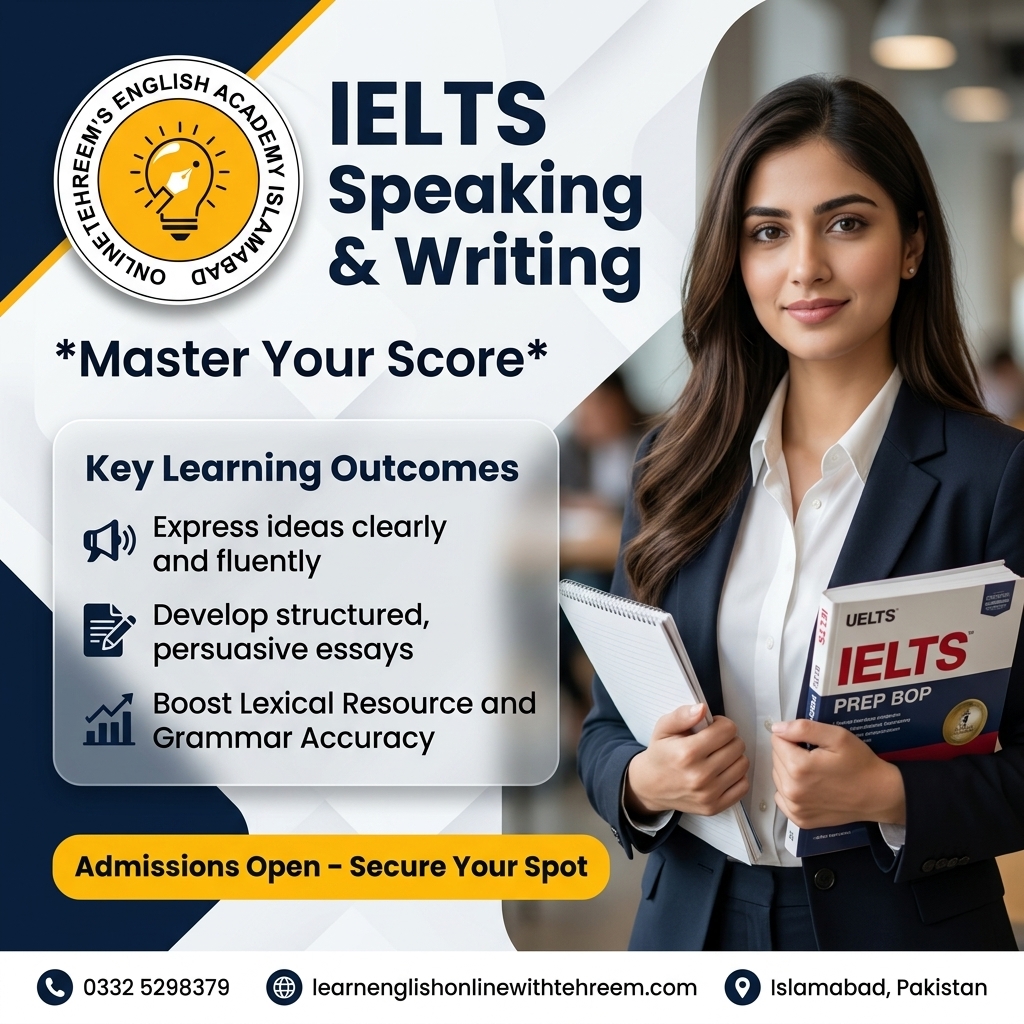
In today’s competitive academic and professional environment, strong English language skills are essential for international education, migration, and career advancement. Among all English proficiency exams, IELTS remains one of the most recognized and widely accepted tests worldwide. Two of the most important sections of this exam are Speaking and Writing, as they directly assess a candidate’s ability to communicate effectively in English. For students seeking success in IELTS Speaking & Writing in Islamabad, Pakistan, focused preparation and consistent practice are key factors in achieving their target band score.
At Tahreem’s English Academy Islamabad, learners receive structured guidance designed to improve communication skills, writing techniques, vocabulary, grammar, and confidence. Whether you are preparing for academic admission, professional registration, or immigration purposes, mastering IELTS Speaking and Writing can significantly improve your overall IELTS performance.
Why IELTS Speaking and Writing Matter
Many IELTS candidates find the Speaking and Writing modules more challenging than Listening and Reading because they require active language production. These sections evaluate how effectively candidates can express ideas, organize thoughts, and communicate in English.
Strong performance in IELTS Speaking & Writing in Islamabad, Pakistan can help students:
- Achieve higher overall IELTS band scores
- Meet university admission requirements
- Improve professional communication skills
- Build confidence in English conversations
- Enhance academic writing abilities
- Prepare for international opportunities
Developing these skills benefits learners not only during the IELTS exam but also in real-world academic and professional settings.
Understanding the IELTS Speaking Test
The IELTS Speaking test is a face-to-face interview that assesses fluency, pronunciation, vocabulary, grammar, and communication skills. The test typically lasts between 11 and 14 minutes and consists of three parts.
Part 1: Introduction and Interview
The examiner asks simple questions about personal topics such as:
- Family
- Studies
- Hobbies
- Work
- Daily routines
This section evaluates basic communication ability and comfort in speaking English.
Part 2: Individual Long Turn
Candidates receive a topic card and have one minute to prepare before speaking for up to two minutes.
This section tests:
- Fluency
- Organization of ideas
- Vocabulary usage
- Speaking confidence
Part 3: Discussion
The examiner asks more detailed questions related to the Part 2 topic. Candidates are expected to express opinions, explain ideas, and discuss broader issues.
Tips for Improving IELTS Speaking
Practice Speaking Daily
Regular conversation practice improves fluency and reduces hesitation.
Expand Vocabulary
Learning topic-specific vocabulary helps candidates express ideas more naturally.
Improve Pronunciation
Clear pronunciation helps examiners understand responses more easily.
Avoid Memorized Answers
Natural communication is more effective than memorized responses.
Develop Confidence
Confidence helps candidates speak more comfortably during the interview.
At Tahreem’s English Academy Islamabad, speaking activities, mock interviews, and interactive discussions help students strengthen their communication abilities.
Understanding the IELTS Writing Test
The IELTS Writing module consists of two tasks that assess grammar, vocabulary, coherence, and organization.
Writing Task 1
For Academic IELTS, candidates describe visual information such as:
- Graphs
- Charts
- Tables
- Processes
For General Training IELTS, candidates write a formal or informal letter.
Writing Task 2
Candidates write an essay discussing a particular topic or issue. This task carries more weight in the overall writing score.
Essay types may include:
- Opinion essays
- Discussion essays
- Problem-solution essays
- Advantages and disadvantages essays
Strong writing requires logical organization, accurate grammar, and clear communication.
Common Challenges in IELTS Writing
Many students preparing for IELTS Speaking & Writing in Islamabad, Pakistan face difficulties in writing because of:
Limited Vocabulary
Using repetitive words can reduce writing quality.
Grammar Errors
Frequent grammatical mistakes affect clarity and band scores.
Weak Organization
Ideas should be presented logically with clear paragraphs and transitions.
Time Management Issues
Many learners struggle to complete both writing tasks within the allotted time.
Lack of Practice
Writing improves through consistent feedback and regular practice.
How to Improve IELTS Writing Skills
Learn Essay Structures
Understanding proper essay organization improves coherence and readability.
Practice Writing Regularly
Frequent writing exercises help build confidence and accuracy.
Focus on Grammar Accuracy
Grammar improvement supports better sentence construction and communication.
Build Academic Vocabulary
Academic vocabulary helps learners express ideas more effectively.
Review and Edit Your Work
Analyzing mistakes helps improve future performance.
At Tahreem’s English Academy Islamabad, learners receive guidance on essay planning, grammar improvement, vocabulary development, and writing techniques.
The Importance of Vocabulary for IELTS Success
Vocabulary is a critical component of both Speaking and Writing modules. Strong vocabulary allows candidates to:
- Express ideas clearly
- Avoid repetition
- Demonstrate language flexibility
- Improve fluency
- Enhance writing quality
Students should focus on learning useful words, collocations, synonyms, and topic-related vocabulary commonly used in IELTS exams.
Role of Grammar in IELTS Speaking and Writing
Grammar contributes significantly to band scores. Accurate grammar helps candidates communicate clearly and professionally.
Important grammar areas include:
- Verb tenses
- Sentence structure
- Linking words
- Subject-verb agreement
- Complex sentence formation
Balanced grammar usage improves both spoken and written communication.
Benefits of Structured IELTS Preparation
A structured approach helps learners identify weaknesses and improve performance systematically.
Benefits include:
- Better understanding of exam requirements
- Improved time management
- Enhanced communication skills
- Increased confidence
- Regular performance evaluation
Students preparing for IELTS Speaking & Writing in Islamabad, Pakistan often achieve stronger language development through organized learning programs and guided practice.
Why Communication Skills Matter Beyond IELTS
The skills developed during IELTS preparation extend beyond the exam itself. Strong communication and writing abilities support:
- University studies
- Professional careers
- Workplace communication
- Public speaking
- International networking
These skills remain valuable long after achieving an IELTS score.
FAQs About IELTS Speaking & Writing
1. How can I improve my IELTS Speaking score?
Practice speaking daily, improve vocabulary, work on pronunciation, and participate in mock speaking sessions.
2. What is the best way to improve IELTS Writing?
Regular writing practice, grammar improvement, vocabulary development, and feedback on essays can significantly improve writing performance.
3. How important is vocabulary in IELTS Speaking and Writing?
Vocabulary plays a major role in expressing ideas clearly and achieving higher band scores.
4. Can beginners prepare successfully for IELTS Speaking and Writing?
Yes. With consistent practice, structured learning, and guidance, beginners can gradually develop the required skills.
5. Why do students struggle with IELTS Writing Task 2?
Many learners face challenges with essay organization, vocabulary usage, grammar accuracy, and time management.
Conclusion
Success in IELTS depends heavily on strong communication and writing abilities. Developing effective skills in speaking and writing helps learners communicate confidently, organize ideas clearly, and perform better during the exam. Focused preparation for IELTS Speaking & Writing in Islamabad, Pakistan can help students strengthen their English proficiency and prepare for academic, professional, and international opportunities.
At Tahreem’s English Academy Islamabad, learners are encouraged to improve fluency, pronunciation, vocabulary, grammar, and writing techniques through structured practice and interactive learning. With dedication, consistency, and proper guidance, students can confidently approach the IELTS exam and continue developing valuable English language skills for future success.