Explore this complete guide to IELTS Preparation in Pakistan for 2026, covering test format, study strategies, preparation schedules, common mistakes, and useful tips.
IELTS remains an important English-language test for students, professionals, and individuals planning to study, work, or pursue other international opportunities. For candidates in Pakistan, effective preparation involves more than simply learning English. It requires an understanding of the IELTS format, regular practice, time management, and a clear strategy for each section.
Whether you are preparing for IELTS Academic or IELTS General Training, the right approach can make your preparation more organised and focused. This guide explains the essential aspects of IELTS Preparation in Pakistan and provides practical strategies you can use throughout 2026.
Understanding IELTS in Pakistan
The International English Language Testing System (IELTS) evaluates your ability to communicate in English through four skills: Listening, Reading, Writing, and Speaking.
Candidates may take IELTS for different purposes, including education, professional requirements, or other international applications. Your purpose determines which version of IELTS may be appropriate.
Before booking a test, check the current English-language requirements of the university, organisation, professional body, or other institution relevant to your plans.
The most important first step is therefore simple: know your goal before you begin preparing.
IELTS Academic vs IELTS General Training
IELTS is available in different versions, and choosing the appropriate test is essential.
IELTS Academic is generally designed for people applying for higher education or certain professional contexts where academic English is required.
IELTS General Training focuses more on practical, everyday English and is commonly associated with work, training, and other non-academic purposes.
The Listening and Speaking components follow the same general format, while Reading and Writing differ between the two versions.
Always verify which test your specific institution or application requires before starting your preparation.
IELTS Test Format and Four Skills
Understanding the four IELTS components helps you create a balanced study plan.
IELTS Listening
The Listening section tests your ability to understand spoken English and identify relevant information.
Effective preparation should include practice with conversations, discussions, and other recordings. Focus on keywords, paraphrasing, numbers, names, and changes in information.
IELTS Reading
Reading tests your ability to understand written information, identify main ideas, locate details, and interpret relationships between ideas.
Developing skimming and scanning skills can help you work more efficiently within the available time.
IELTS Writing
Writing requires you to present ideas clearly, logically, and appropriately for the task.
IELTS Academic and General Training have different Task 1 requirements, while Task 2 involves an essay.
Regular writing practice is important because students need to improve both language accuracy and the ability to organise ideas effectively.
IELTS Speaking
The Speaking test assesses your ability to communicate verbally through a structured interview.
Candidates should practise answering questions naturally, extending their responses, explaining ideas, and speaking with clear pronunciation and appropriate fluency.
How to Start IELTS Preparation in Pakistan
A good preparation journey begins with an honest assessment of your current English ability.
Take a realistic practice test and review your performance in all four skills. You may discover that your Reading is strong while Writing needs considerably more attention, or that you understand spoken English well but hesitate during Speaking.
Once you know your strengths and weaknesses, set a target and create a study schedule.
Your plan should consider:
- Current English proficiency
- Required IELTS band score
- Academic or General Training test
- Available preparation time
- Daily study hours
- Weak and strong skills
- Test date
A personalised plan is usually more useful than copying another student’s timetable.
9 Effective IELTS Preparation Strategies for Pakistani Students
1. Assess Your Current English Level
Don’t begin by guessing what you need to improve.
Take a diagnostic test and analyse the results. Identify specific problems rather than simply deciding that your English is “weak.”
For example, your Reading problem might be vocabulary, while your Writing problem could be paragraph organisation.
Specific problems require specific solutions.
2. Set the Right IELTS Target Score
Your target score should be based on your actual requirement.
Universities, employers, professional organisations, and other institutions may have different requirements. Check the relevant requirements before establishing your preparation target.
Once you know the target, compare it with your current performance and create smaller weekly goals.
3. Build a Daily Study Routine
Consistency is one of the most important elements of successful preparation.
A practical daily routine might include:
- 30 minutes of Listening
- 30 minutes of Reading
- 30 minutes of Writing or Speaking
- 15–20 minutes of vocabulary review
The exact schedule can change depending on your availability.
If you are a university student or working professional, shorter sessions spread throughout the day may be easier to maintain than one very long study session.
4. Improve Listening Through Regular Exposure
IELTS Listening practice should not be limited to test questions.
Include English in your daily routine through educational videos, interviews, podcasts, lectures, and conversations.
Try to understand different accents and speaking styles.
During IELTS practice, analyse incorrect answers carefully. Ask whether you missed the information because of vocabulary, concentration, speed, pronunciation, or a failure to recognise paraphrasing.
5. Develop Reading Speed and Comprehension
Many Pakistani candidates struggle with Reading because they translate every sentence mentally or spend too much time on individual questions.
Instead, practise understanding the overall meaning first.
Develop the ability to:
- Skim for main ideas
- Scan for specific information
- Identify keywords
- Recognise synonyms
- Understand paraphrases
- Locate supporting evidence
Don’t assume the wording in the question will appear exactly in the passage. IELTS frequently tests your ability to recognise the same idea expressed differently.
6. Strengthen IELTS Writing Skills
Writing requires consistent practice and constructive feedback.
When reviewing your essays, look at:
- Task response
- Coherence and organisation
- Vocabulary
- Grammar
- Paragraph structure
- Sentence variety
- Spelling
Don’t simply count how many words you wrote. Ask whether every paragraph contributes to answering the question.
For Task 2, practise presenting a clear position and developing your ideas with relevant explanations and examples.
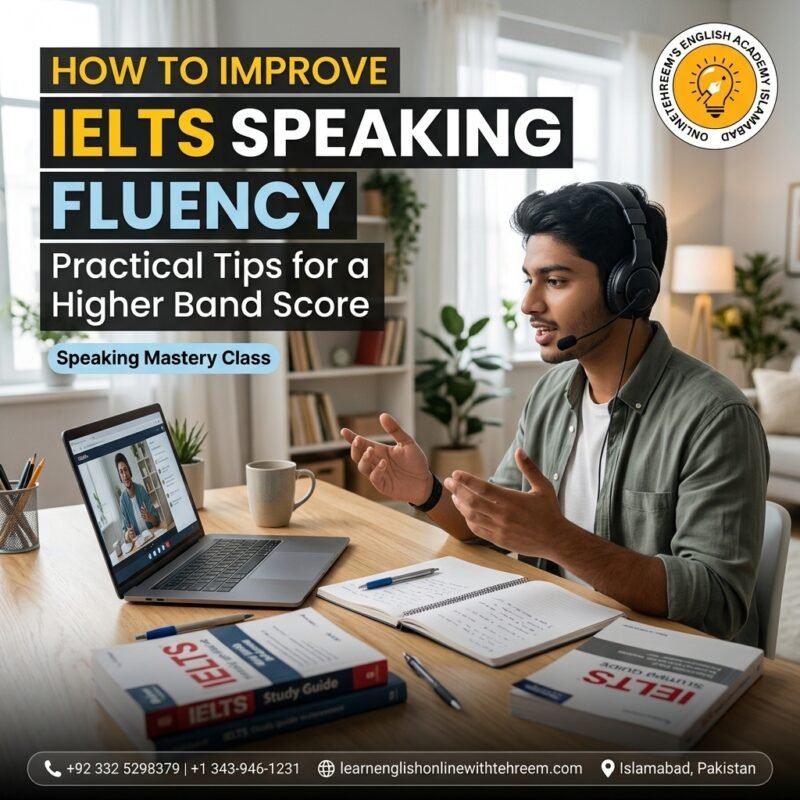
7. Practise English Speaking Every Day
Many candidates understand English but become hesitant when they need to speak continuously.
The solution is regular speaking practice.
Talk about:
- Your studies
- Your hometown
- Your hobbies
- Your future plans
- Technology
- Education
- Social issues
- Everyday experiences
Record yourself occasionally and listen for long pauses, repetitive vocabulary, unclear pronunciation, and incomplete answers.
You don’t need to eliminate every mistake. The goal is to communicate naturally and clearly.
8. Expand Vocabulary and Grammar
Vocabulary and grammar support all four IELTS skills.
Rather than memorising huge lists of complicated words, learn useful vocabulary in context.
Create topic-based vocabulary groups around areas such as:
- Education
- Environment
- Technology
- Health
- Employment
- Society
- Transport
For grammar, focus on accuracy first. Complex sentences are useful only when you can construct them correctly.
9. Use Mock Tests and Error Analysis
Mock tests help you practise under realistic conditions.
However, completing a test without reviewing your mistakes limits its value.
After each mock test, create an error log.
Record:
What went wrong?
Why did it happen?
What will I do differently next time?
Over several weeks, patterns will begin to emerge. Those patterns should guide your next stage of preparation.
IELTS Preparation Schedule for 2026
A four-week schedule can provide a useful starting point.
Week 1 — Foundation: Understand the test format, take a diagnostic test, and identify weak areas.
Week 2 — Skill Development: Focus on individual Listening, Reading, Writing, and Speaking techniques.
Week 3 — Intensive Practice: Introduce more timed exercises and practise complete sections.
Week 4 — Exam Readiness: Take mock tests, analyse mistakes, revise key strategies, and work on time management.
If your English foundation needs significant improvement, extend this schedule rather than rushing through it.
Common IELTS Preparation Mistakes in Pakistan
Several mistakes can make preparation less effective.
Studying without a plan: Random practice makes progress difficult to measure.
Focusing only on vocabulary: Vocabulary is important, but IELTS requires four integrated skills.
Avoiding Speaking practice: Speaking confidence develops through actual speaking.
Memorising essays: Memorised responses may not fit the question and can limit your ability to express ideas naturally.
Ignoring feedback: Students may not recognise recurring Writing or Speaking problems without an outside perspective.
Taking mock tests without analysis: A score alone doesn’t explain how to improve.
Avoiding these mistakes can make your preparation more focused and productive.
Online vs Classroom IELTS Preparation
Both online and classroom preparation can be useful, depending on your learning style and schedule.
Online preparation can provide flexibility and allow students to study from home. It can be particularly convenient for people balancing IELTS preparation with university or work.
Classroom preparation provides a more traditional learning environment and direct interaction with instructors and other learners.
The quality of the preparation programme matters more than the format alone. Look for a learning approach that provides structured lessons, relevant practice, feedback, and opportunities to work on individual weaknesses.
How Tahreem’s English Academy Islamabad Can Support IELTS Candidates
For learners seeking structured preparation, Tahreem’s English Academy Islamabad can be considered as part of their IELTS preparation journey.
A useful IELTS programme should help candidates understand the test format, practise all four skills, identify areas for improvement, and develop effective exam strategies.
Students can also combine structured learning with independent practice at home. Regular revision, speaking practice, writing exercises, and mock tests can reinforce what they learn during guided preparation.
Ultimately, the most effective preparation plan is one that matches your current English level, target score, schedule, and specific learning needs.
Frequently Asked Questions About IELTS Preparation in Pakistan
How long does IELTS preparation take in Pakistan?
There is no fixed preparation period for every candidate. It depends on your current English proficiency, target score, previous IELTS experience, and amount of daily study time. Some candidates may need several weeks, while others may benefit from a longer preparation period.
Is IELTS difficult for Pakistani students?
IELTS can be challenging, particularly if a candidate has limited experience with English communication or the test format. However, understanding the exam, practising consistently, and working on individual weaknesses can make preparation more manageable.
Which IELTS test should I take?
The appropriate test depends on your purpose. IELTS Academic is generally associated with higher education and certain professional contexts, while IELTS General Training is used for various non-academic purposes. Always confirm the requirements relevant to your specific application.
Can I prepare for IELTS at home?
Yes. Self-study can be effective when supported by suitable preparation materials, a consistent schedule, practice tests, and regular skills development. Professional feedback can be particularly helpful for Writing and Speaking.
What is the best IELTS preparation strategy?
The most effective approach combines a diagnostic assessment, a realistic target, regular practice in all four skills, vocabulary and grammar development, timed exercises, mock tests, and careful analysis of mistakes.
Conclusion
Effective IELTS Preparation in Pakistan requires more than simply completing practice questions. It involves understanding the test, identifying your weaknesses, developing all four English skills, managing your time, and consistently learning from mistakes.
For candidates preparing in 2026, start with a clear goal and build a realistic study routine around your schedule. Practise Listening, Reading, Writing, and Speaking regularly, and use mock tests to measure your progress.
Most importantly, remember that preparation should be purposeful. Every practice session should help you understand something better, correct a recurring mistake, or become more comfortable with the demands of the IELTS test.
With a structured approach and consistent effort, you can make your IELTS preparation more organised, focused, and productive.