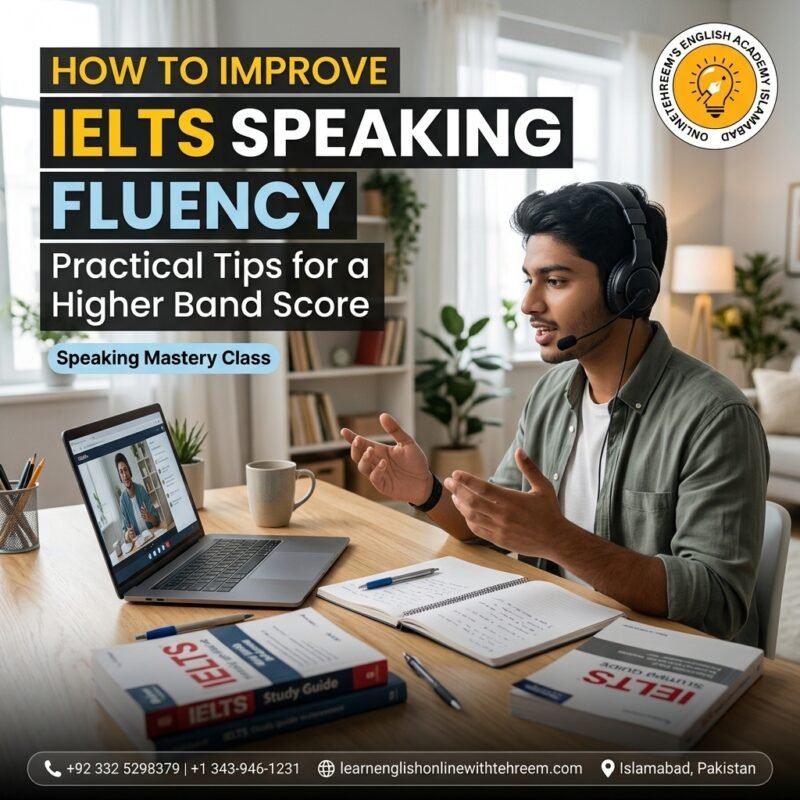
Learn how to improve IELTS Speaking fluency with practical daily exercises, vocabulary-building techniques, pronunciation tips, and proven preparation strategies.
IELTS Speaking can be challenging for students who understand English but struggle to express their ideas smoothly. You may know the right words yet hesitate while speaking, repeat phrases, or find it difficult to develop an answer. These challenges are common among IELTS candidates, particularly those who rarely practise speaking English in everyday situations.
Learning how to improve IELTS Speaking fluency requires consistent practice, effective techniques, and a clear understanding of the IELTS Speaking test. By developing your vocabulary, organizing your thoughts, and practising natural conversations, you can become more comfortable expressing yourself in English.
What Is Fluency in IELTS Speaking?
Fluency refers to your ability to speak at a reasonably natural pace, develop your ideas, and continue speaking without excessive hesitation. It does not mean speaking as quickly as possible or avoiding every pause.
In the IELTS Speaking test, fluency and coherence are assessed alongside lexical resource, grammatical range and accuracy, and pronunciation.
To improve your speaking performance, focus on expressing ideas clearly, connecting your thoughts logically, and maintaining a natural rhythm. Short pauses to think are normal, but frequent long pauses and repeated restarts can make communication less effective.
7 Effective Ways to Improve IELTS Speaking Fluency
1. Practise Speaking English Every Day
Regular speaking practice helps you become more comfortable forming sentences without translating every thought from your first language.
Set aside 15–30 minutes daily to discuss familiar topics such as education, hobbies, technology, travel, work, or daily routines.
You can practise by describing your day, explaining an opinion, or summarizing something you have read. Start with simple sentences and gradually develop longer responses.
Consistency is more valuable than practising for several hours only once a week.
2. Think in English Instead of Translating
Translating every sentence from your native language into English can interrupt your speaking flow. It may also cause hesitation when you cannot find a direct translation.
Try thinking about everyday activities in English. For example, describe what you are doing, plan your daily schedule, or explain how you would complete a familiar task.
You do not need to think in perfect English. The goal is to become more comfortable connecting ideas directly with English words and expressions.
3. Learn Useful Vocabulary and Phrases
A limited vocabulary can make it difficult to explain your ideas or answer unfamiliar questions. However, memorizing long word lists is not always the most effective approach.
Learn vocabulary in meaningful groups related to common IELTS topics.
For example, when discussing education, you might learn expressions such as:
- Academic performance
- Practical skills
- Learning environment
- Career opportunities
- Access to education
Practise using these expressions in complete sentences. Also learn natural phrases for explaining opinions, giving examples, and describing experiences.
Use advanced vocabulary only when it fits naturally. Clear and accurate language is more useful than complicated words used incorrectly.
4. Use the PREP Technique to Organize Answers
One reason candidates hesitate is that they do not know what to say next. A simple structure can help you organize your thoughts quickly.
The PREP technique stands for Point, Reason, Example, and Point.
- Point: Give your direct answer.
- Reason: Explain why you think so.
- Example: Provide a relevant example.
- Point: Briefly reinforce your main idea if appropriate.
For example, if asked whether reading is important, you could explain that reading is valuable because it improves vocabulary, provide an example of learning new words from books, and summarize how this benefits communication.
This technique is particularly useful for IELTS Speaking Part 3, where candidates need to explain opinions in greater depth. Use it flexibly rather than forcing every answer into the same format.
5. Record Yourself Speaking
Recording your voice is a practical way to identify speaking habits you may not notice during conversation.
Choose an IELTS-style question and speak for an appropriate length of time. Then listen to the recording and check:
- How often you pause unnecessarily
- Whether you repeat words or phrases
- How clearly you pronounce words
- Whether your ideas follow a logical order
- Whether you use a variety of sentence structures
Choose one or two areas to improve in your next recording. Trying to correct everything at once can make practice overwhelming.
6. Improve Pronunciation and Speaking Rhythm
Good pronunciation helps listeners understand your ideas. You do not need to imitate a British, American, or Australian accent to perform well.
Focus on pronouncing words clearly, stressing important syllables, and using natural sentence rhythm. Pay attention to word endings, particularly when they affect meaning, such as plural endings and past-tense forms.
Listening to English conversations, repeating short passages, and recording your own speech can help you notice differences between your pronunciation and natural spoken English.
7. Practise With IELTS Speaking Questions
Practising realistic IELTS questions helps you become familiar with the test and learn how to respond without excessive preparation time.
For Part 1, practise giving direct answers with a little explanation. In Part 2, learn to organize your ideas around the cue card and use the preparation time to make brief notes. In Part 3, practise explaining opinions, comparing ideas, discussing causes, and considering possible solutions.
Avoid memorizing complete answers. Examiners may ask questions differently, and memorized responses can sound unnatural or fail to address the actual question.
How to Improve IELTS Speaking Fluency in Each Test Part
IELTS Speaking Part 1: Short Questions
Part 1 focuses on familiar topics such as home, work, studies, hobbies, and daily life.
Answer the question directly, then add a reason or detail.
For example:
Question: Do you enjoy reading?
Sample answer: Yes, I enjoy reading because it helps me relax and learn new things. I particularly like reading articles about education and personal development.
The response is clear, relevant, and developed without becoming unnecessarily long.
IELTS Speaking Part 2: The Cue Card
In Part 2, you receive a topic and have one minute to prepare before speaking for up to two minutes.
Use your preparation time to note keywords rather than writing complete sentences. Organize your ideas in a logical sequence, such as the background, main details, personal experience, and explanation of why the topic matters to you.
Practise speaking for the full available time when the topic allows it, but do not add irrelevant details merely to keep talking.
IELTS Speaking Part 3: Discussion Questions
Part 3 involves more abstract questions related to the Part 2 topic. You may need to compare past and present situations, explain social changes, or discuss advantages and disadvantages.
Develop your answers by explaining your reasoning and providing examples. You can also acknowledge different perspectives where relevant.
For example, when discussing whether technology improves education, explain its benefits, recognize possible limitations, and support your opinion with a realistic example.
A Simple 7-Day IELTS Speaking Fluency Practice Plan
A short routine can help you build a consistent speaking habit.
| Day | Practice activity |
|---|---|
| Day 1 | Answer 10 Part 1 questions aloud. |
| Day 2 | Record yourself speaking about one cue-card topic. |
| Day 3 | Practise explaining opinions on education and technology. |
| Day 4 | Learn 10 useful phrases and use them in spoken sentences. |
| Day 5 | Listen to a short English recording and summarize it aloud. |
| Day 6 | Complete a mock speaking test covering all three parts. |
| Day 7 | Review your recording, identify repeated mistakes, and practise again. |
Repeat the routine with new topics and gradually increase the difficulty. Track your progress by noting changes in hesitation, clarity, vocabulary, and answer development.
Common Mistakes That Reduce Speaking Fluency
Avoid these habits when preparing for IELTS:
- Speaking too quickly: Fast speech can reduce clarity. Aim for a natural, controlled pace.
- Memorizing complete answers: Prepared responses may not fit the question and can sound unnatural.
- Using unnecessary fillers: Frequent expressions such as “umm,” “you know,” and “actually” can interrupt communication.
- Giving answers that are too short: When appropriate, explain your answer with a reason or example.
- Forcing difficult vocabulary: Incorrect word choices can make your meaning less clear.
- Ignoring grammar: Fluency matters, but grammatical accuracy also contributes to your overall Speaking performance.
- Avoiding practice because of mistakes: Mistakes are useful when you identify them and work on correcting them.
Improve IELTS Speaking With Tahreem’s English Academy Islamabad
Students preparing for IELTS may benefit from structured speaking practice, realistic questions, and constructive feedback. Tahreem’s English Academy Islamabad is an option learners can explore when looking for English-learning support.
When considering a preparation course, ask whether it includes practice for all three Speaking parts, pronunciation guidance, vocabulary development, mock speaking tests, and feedback on fluency and grammar.
The right learning approach should help you identify your specific difficulties and practise the skills you need to improve. Regular speaking practice outside lessons is also important for developing confidence and consistency.
Frequently Asked Questions
1. How can I improve IELTS Speaking fluency quickly?
Practise speaking every day, record your answers, learn useful phrases, and respond to IELTS-style questions under realistic conditions. Review your mistakes and focus on one or two areas at a time.
2. How many hours should I practise IELTS Speaking daily?
Many students can begin with 15–30 minutes of focused speaking practice each day. The ideal amount depends on your current level, target score, and preparation schedule. Consistent practice with feedback is more useful than speaking for long periods without reviewing your performance.
3. Is it necessary to speak English without hesitation?
No. Natural speakers pause occasionally to think. The goal is to avoid excessive hesitation, organize your thoughts effectively, and communicate ideas smoothly.
4. Does using advanced vocabulary improve IELTS Speaking scores?
Vocabulary variety and accuracy are important, but difficult words do not automatically lead to a higher score. Use appropriate expressions, explain your ideas clearly, and demonstrate a range of vocabulary naturally.
5. Can I improve IELTS Speaking fluency without a speaking partner?
Yes. You can practise by recording answers, speaking aloud about everyday topics, repeating short audio passages, and completing mock questions. A speaking partner or teacher can provide additional feedback, but independent practice is still valuable.
Conclusion
Learning how to improve IELTS Speaking fluency requires regular practice, effective answer development, useful vocabulary, and clear pronunciation. By practising all three parts of the test, recording your responses, and reviewing your mistakes, you can develop more natural speaking habits.
Focus on communicating ideas clearly rather than speaking as quickly as possible or memorizing perfect answers. With consistent effort and a practical study routine, you can work toward stronger IELTS Speaking performance and greater confidence in English communication.