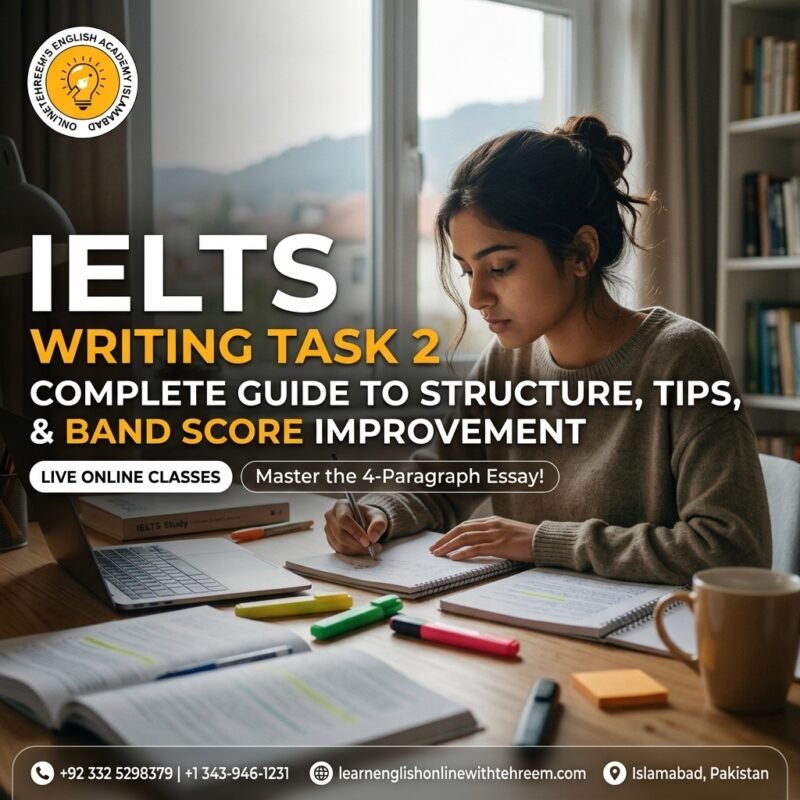
The Complete IELTS Writing Task 2 Guide Part A: Structure, Band Score Tips, Strategy, Essay Types and How to Improve Your Vocabulary for Writing IELTS (and speaking).
IELTS Writing Task 2 is an important component of the IELTS writing section. It assesses if your arguments are clear, whether ideas flow logically and how well you can use English as a language. It is not easy for most students to write a good organized essay in 40 minutes while having to comprehend difficult questions and substantiate their views with examples.
Best IELTS Writing Task 2: Complete Guide to Structure, Tips and Band Score Improve This essay format is for Task 2 of the General Training Module and covers common question types, assessment criteria and ways to raise your academic writing level. These five strategies below will help you prepare for the IELTS Academic or General Training, structured in a way that helps form better preparation habits.
Understanding IELTS Writing Task 2
The IELTS Writing Task 2 is an essay based on a question, statement or an issue. You need to support your points; elaborate on the arguments you make and respond to every question in a given task.
This task is 250 words minimum (around 40 minutes). It has an important place in preparing for the exam, because Task 2 contributes twice as much to the overall IELTS Writing score as Task 1.
These touch on common subject areas such as education, technology, environment, health, employment, public transport and social issues. It is good to practice as this tends to make you comfortable when you are developing an argument about something which may be alien or new to you.
IELTS Writing Task 2: How to structure your essay
Structure in your essay makes it easier for examiners to pick up on what you are trying to convey. This typically takes four paragraphs, but for some questions there may be a fifth paragraph.
1. Introduction
The introduction introduces the topic and provides your thesis statement. Draw the local energy minimum in your own words Then give an opinion or summarise the things you will cover, depending on the type of question.
Don’t replicate the question verbatim. It should be to the point and relevant instead of all generic stuff in your introduction.
2. First Body Paragraph
The main idea of the body paragraph No 1Decision is that you identify one idea. A paragraph should start with a clear topic sentence, then add your reasoning and possibly an example.
If, for example, the topic of your essay is how online education can be beneficial in terms of schedule flexibility, you may provide an explanation on how it allows students to keep up with other responsibilities. Instead of doing laundry list type benefits, the idea needs to be developed completely.
3. Second Body Paragraph
In the second body paragraph, use to discuss an additional key relevant argument, counterargument or solution. The purpose depends on the precise question.
Try to make every paragraph add something new to your answer. It is better to develop your paragraph than to include many points in a short explanation.
4. Conclusion
A conclusion consolidates your main claim and reasserts your point when necessary. It’s too early to start adding any new evidence or an entirely new concept here.
A cohesive conclusion provides your essay with an appropriate sense of closure and reinforces the direction of the response you have already offered in this essay.
Most Frequent IELTS Writing Task 2 Essay Types
It is essential to know about the type of question as each question can be solved differently.
Opinion Essays
Opinion Essays: They require you to agree or disagree with a statement [or degreee – they can be watered down].
Take a clear position and back it up with evidence. You can agree wholeheartedly, disagree completely or take a moderate stance so long as your position directly addresses the question.
Discussion Essays
Lastly, discussion essays ask you to analyse two sides and sometimes give your own opinion.
Present both sides of the equation objectively, and dedicate time to covering both. If the question asks for your opinion, you must state it, because you will confuse the examiner if they have to read between the lines.
Advantages and Disadvantages Essays
These essays require you to write about both the advantages and disadvantages of any issue. Others questions ask whether the positives outweighs the negatives.
Be careful with your organization and make your overall judgment clear when necessary. Support your points with sound reasoning and relevant examples.
Problem and Solution Essays
These can be problems and solutions essays, where you identify a cause or problem then offer one or more appropriate solutions.
Lays out why the problem is happening, its consequences as that becomes relevant, and are actionable solutions. Link each solution to their problem they are created to serve.
Two-Part Question Essays
These questions consist of one set of two interrelated questions, which leads to answering both. Identify all parts of the prompt, and structure sufficient content to respond to both.
Even if your essay is well written, not fully addressing the question you are asked can weaken your Task Response.
IELTS Writing Task 2 Tips to Get a Better Band Score
Actually, preparing well means so much more than memorizing essay templates! These are practical ways to improve your writing over time.
Understand the Question Before Writing
Highlight the action words followed by the topic till further parts of the question. Determine if the assignment requires you to provide your opinion, contrast positions, explain causes or propose solutions.
Take couple of minutes to prep your response. It eliminates redundancy and allows you to concentrate on your business.
Develop Ideas with Examples
Let each main argument be elaborated on. Do not claim that technology makes education better; explain how digital tools put learning resources in students’ hands or allow them to revisit challenging concepts.
They should have examples that relate and seem believable. You do not need to invent statistics or include complicated research findings to build a solid argument.
Improve Academic Vocabulary
Vocabulary is also a key element of the IELTS Writing Task 2 assessment. Collect useful vocabulary for common IELTS topics such as: education, environment, technology and society
Choose the right word instead of using 10000 words. Using a word wrong can cause your argument to be non-existent.
Use Linking Words Naturally
Linking words/phrases like however — therefore — for example, or in contrast will help you to relate ideas. But overusing linking words might give your essay a robotic feel.
Concentrate on logical relationships—In between sentences and in between paragraphs. Transitions are only a tool used to improve clarity.
Practice Grammar and Sentence Variety
An effective essay writes proper balance between simple and complex sentence. Exercise relative clauses, conditionals and cause-effect sentences.
Common mistakes about articles, prepositions, subject-verb agreement, punctuation and tenses. If you repeat a mistake, the second time might be correct; in order to avoid confusion of this kind, it is important that one goes back and looks carefully at what he has written.
Manage Your Time
If you really want to do your best, I suggest a realistic 40-minute plan with about five minutes for planning, roughly 28 minutes for writing and seven minutes reviewing or refining your essay.
Tweak this schedule based on your own writing speed. Allocate the time to ensure grammar, spelling, formatting of paragraphs and that all components of the question are covered.
Most Common Errors in IELTS Writing Task 2
There are many mistakes that can pull down your essay even when your command of English is decent.
Do not Go off-topic: Make all arguments related to the query.
Repetition of ideas: Present unique arguments in place of paraphrasing the same idea.
Memorization of entire essays: What you have prepared may not be what the question is going to ask. Learn flexible structures instead.
Incorrect use of difficult vocabulary: Write with words that you understand (and can apply correctly)
Ignoring part of the question: Make sure you address every aspect of your prompt.
Ranked Maximum Number of Words: Write below 250 words: Meet the Minimum Word Count and Develop Arguments It Fully.
Neglecting to Proofread: Save time on fixing preventable language mistakes.
Join Us In IELTS Writing Task 2 Preparation at Tahreem’s English Academy Islamabad
In the case of IELTS, we need to provide students with structured writing practice, an understanding of what aspects are assessed when their writing is scored, and ongoing feedback that enables them to improve repeatedly. One option that learners may be able to explore for English-learning support is Tahreem’s English Academy Islamabad.
When selecting a preparation course, ask whether the course allows practice with various essay types, guidance on planning essays, grammar development and vocabulary acquisition integrated into all writing activities, and feedback on written work. Studying in this particular manner makes it simpler for students to detect their weaknesses and practice correcting them with further, similar essays.
The ideal way to prepare is one that fits your current level of English, desired score and study time available.
Frequently Asked Questions
1. You have to write a minimum word count of 250 in your IELTS Writing Task 2 as the content is evaluated by words instead of marks.
You need to write at least 250 words. Candidates should try to put forward the ideas as clearly as possible without adding repetitive words and phrases just to increase text size!
2. What can I do to achieve a higher band score for my IELTS Writing Task 2?
You apply Maslow hierarchy of needs to different types of essays, prepare a plan before writing one, argue with relevant explanations and learn through your mistakes. A good teacher can also find recurring weaknesses thru feedback.
3. Using A Four-Paragraph Essay For IELTS Writing Task 2
Yes. For many questions, a good approach is to write an introduction, two body paragraphs with development and then conclude. Depending of the essay some essays might need extra paragraphs so use whichever structure is best to answer the question.
4. IELTS Writing Task 2: Are memorized templates allowed?
You will learn different organizational patterns and essay-writing vocabulary, but never memorize a full essay. It must respond to the question specifically and articulately express those ideas.
5. Now, how long do you think someone should spend on IELTS Writing Task 2?
Approximately 40 minutes is recommended. Spend a fraction of that time planning and writing your essay, proofreading it for grammar issues, clarity, and completeness.
Conclusion
An essay for an IELTS Writing Task 2 is not some wild rambling that lacks structure, order of ideas, arguments or vocabulary… and either goes over time limit or takes significantly less than needed.
Knowing essay types, properly planning your responses, practicing consistently and reviewing your errors can help to build better academic writing skills. You hear someone in the room asking you a question and this is your specific moment where it counts. You can prepare for your IELTS Writing goals with more confidence through regular practice and good feedback.