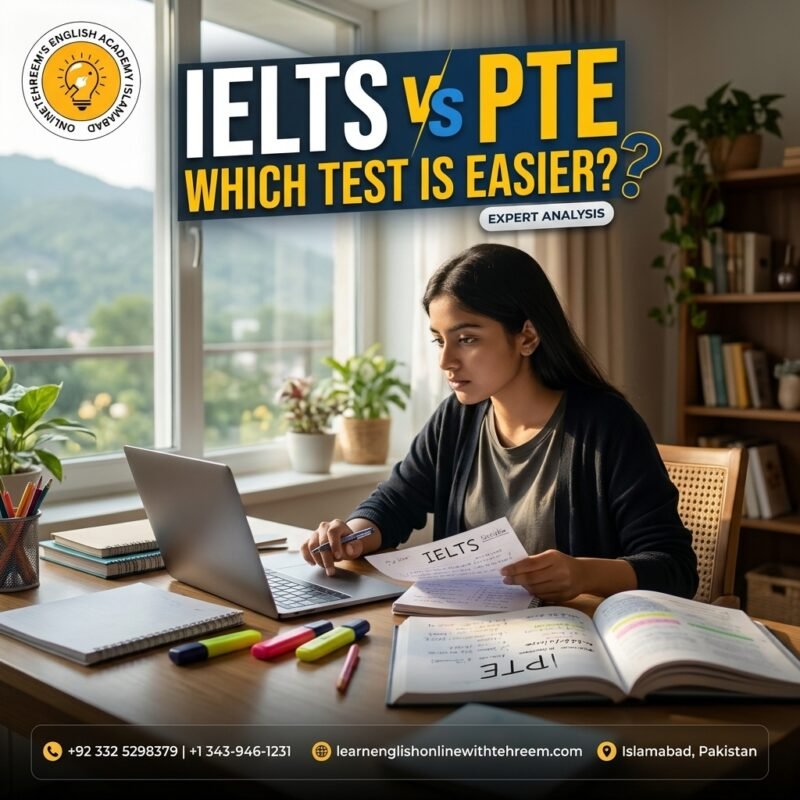
IELTS vs PTE: Learn which English test is easier in terms of exam format, speaking, writing and scoring & preparation Tips to choose the right one.
There can be overwhelming confusion on which English test to choose between IELTS or PTE, especially in case you are a candidate looking to study abroad, apply for immigration or meet an English language requirement. They are two tests which measure your use of the English language, and not only differ in format and delivery but also scoring and how you show what you can do with the language.
Numerous students wonder; IELTS vs PTE; Which is simple a more straightforward test? The answer depends upon your knowledge of English, computer ability and how confident you pair fled to speak in an interview. PTE is computer-based, so many candidates see this option as more convenient while some of the examinees want to choose IELTS because the Speaking test consists of a conversation with an examiner?
The guide below compares IELTS and PTE to make you aware of the differences helping you select the right one.
What Are IELTS and PTE?
The International English Language Testing System (IELTS) and the Pearson Test of English (PTE) are popularly used as tests of English proficiency by institutions, employers and immigration authorities.
IELTS tests Listening, Reading, Writing, and Speaking. candidate then complete Listening, Reading and Writing either in paper or on the computer while Speaking is with an examiner face-to-face, or by video call (where available).
PTE Academic is a computer-based English test that tests Listening, Reading, Speaking and Writing through integrated tasks. At the assessment center, candidates are required to speak into a microphone as well as type answers and listen to recorded stuff.
Both tests can be viable options, but you will need to verify that your selected university, organization or immigration authority accepts the test and mark allotted to it before booking.
IELTS vs PTE: Key Differences
A summary of major differences between IELTS Academic and PTE Academic is illustrated in the table below.
Feature
IELTS Academic
PTE Academic
Test format
In case none of your available options are conflicting with any of the above, either paper-based or computer-based
Computer-based
Speaking test
Always an interview with the examiner usually
Responses recorded through a microphone
Listening
Audio recording and different types of questionnaires
Audio Calls and built-in types of questions
Reading
Various forms of questions based on passages.
Computer-based reading tasks
Writing
Essays and other writings, including image description or letter writing (depending on test type)
Typical writing tasks that you see computer-based, even integrated tasks.
Scoring
Band scores from 0 to 9
Scores on a 10–90 scale
Best preparation approach

Pre-Interview Hone Language skills, do Task practice & record for later playback
Ability to do simple tasks, computer-based task practice, fluency in language/copyleft
These two tests will use different scoring systems, and therefore scores between them cannot be directly compared by lining up the corresponding numbers. Always verify the score requirements with the respective dept. or authority to which you will be applying.
Is IELTS Easier Than PTE?
IELTS might be less daunting for candidates who are used to speaking in person, elaborating on ideas with examples or writing full answers in a pen and paper environment instead of being reliant on going through the computer.
People who prefer talking with a person, rather than recording answers into a microphone may find the Speaking test attractive. There are different types of these tests IELTS depending on availability and location.
But IELTS may not be suitable for you, if: You find it tough to plan essays, and/or understand different accents, or cannot manage time during Reading and Writing tasks.
IELTS may suit you if:
- You are at ease talking to an examiner.
- You do well with natural conversation for Speaking.
- You feel confident with essay writing and structuring arguments.
- You can handle various kinds of questions in a time-constrained environment.
- If IELTS is accepted at the institution or authority you are targeting.
The simplest test is not always the one with the most recognizable structure. Evaluate your existing skill levels and the test requirements before choosing.
Is PTE Easier Than IELTS?
Candidates who prefer computer-based tests and feel more comfortable speaking into a microphone may find the PTE to be the easier option. The tasks can be integrated and candidates can practice skills together, for instance Listening & Speaking or Reading& Writing.
It could also attract people who would rather type their responses on a computer than write it out in their own handwriting.
But it does not mean PTE is easier by default! A candidate might have difficulty speaking clearly under time pressure or not able to accurately reproduce what is said, or struggle to perform in new question types.
PTE may suit you if:
- You are confident with a computer and a keyboard.
- You like to record your Speaking responses.
- You will find you can speak at a consistent pace.
- You are open to doing integrated and timed tasks.
The college or body you are applying for, accepts PTE Academic as a valid test.
PTE preparation is not just about cramming templates. Strong skills in listening, pronunciation, grammar, vocabulary and comprehension are still beneficial.
Who’s in speaking is easier : IELTS or PTE
One of the biggest differences between the two tests is Speaking.
TIP: IELTS is where you answer questions directly from an examiner. It consists of familiar topic questions, a longer solo spoken task and a discussion. Many candidates like the relaxed atmosphere, whereas some of them respond with nervousness in an interview.
While you perform speaking tasks using a mic in PTE Academic. These comprise Reading Aloud, Repeat Sentence, and Describe Image. You will need to learn how to comprehend instructions, keep track of your time, and vocalize into the recording system.
Pick IELTS Speaking if you are more comfortable writing free thinking in a conversation.
If you enjoy computer work and can practice speaking clearly on time, then think PTE Speaking.
The format does not eliminate the need for preparation. Choose based on where you think your strengths lie not which test sounds easier.
Which Is Easier IELTS vs PTE Writing
Both tests test how well you communicate concepts with written English, but the structure of these tasks is different.
IELTS Academic Writing involves the following: Describing visual information (Task 1) Writing an essay (Task 2) IELTS General Training Writing has a letter and an essay. They should have to organize concepts, answer the question, use good words and show rare frequency of grammatical mistakes.
Computer-based writing tasks, including summarizing (summaries written text) and essay writing are among the tasks featured in PTE Academic. One of the tasks mixes a few data from more than one language.
Candidates who have no trouble in planning and developing statements and structured essays may find that IELTS fits their academic requirements. Candidates who may excel in PTE might be those with a preference for typing, as well as the ability to quickly follow task instructions.
In either case, an appropriately-worked through structure and precise language pays more than using sophisticated vocabulary inaccurately.
The IELTS Reading and Listening vs the PTE
With either test, Reading and Listening can be tough; however, the types of questions and timing differ.
In IELTS reading, you need to understand the passages and answer question types such as matching headings, identifying information and filling in blanks. IELTS Listening tests whether you can follow conversations and monologues and pick out key details.
PTE consists of various computer-based question types; some questions even feature data integration, combining elements from Reading, Listening, Speaking and Writing.
Both tests may be manageable with appropriate practice, if you are able to identify information within writing. Listen regularly, to a range of accents being spoken; listen and review mistakes if you have difficulty comprehending the audio.
Try sample questions for both tests before making your choice. So, then you are presented with data as to which format is more natural for you and where you need to focus your practice.
Which Exam Is Easier to Score?
There is no universal answer. Your English skills, familiarity with the test format, preparation methods and how well you test on the day will all determine your score.
IELTS provides scores on a scale of 0 to 9 (band score) and PTE Academic uses a broader score ranging from 10–90. Different tests have different scoring standards, so the numbers should not be equated.
If you want to increase the odds of hitting your target:
- Find out the specific score that you need for your application.
- Sit through a mock test for every exam.
- Compare your strengths and weaknesses.
- To revisit the types of questions that you find challenging
- Practice under realistic time limits.
- Regularly check your progress with authentic practice stuff.
Don’t choose a test because someone says it gives better scores. opt for the examination that fits your caliber and is recognized in accordance with what you want to do.
For study or immigration purposes which test is better?
The appropriate test varies, depending on your destination, institution, visa category and application criteria.
Note that some universities, accept both IELTS Academic and PTE Academic while others may only accept certain tests, or may have a minimum score requirement. Even immigration authorities may have guidelines regarding the versions of the tests, minimum scores and validity.
Before booking, verify:
- Acceptance of the test by your respective university or authority.
- Please one, which version of the test is required.
- The aggregate score and individual skills requirements
- If the result satisfies any conditions for validity or application
A student applying to a university, for example, should refer to that university’s site for up-to-date English language standards as opposed to scrolling through general guidance about IELTS or PTE.
Selecting IELTS vs. PTE
These are practical questions to inform your decision.
- Are you comfortable speaking with an examiner or would you prefer to record responses?
- Do you write essays and type on a computer with confidence?
- What test sample questions do you get at more easily?
- Which exam is accepted by your destination college or authority?
- How much do you need, and how long can you prepare?
Take a brief practice test of both exams/versions, then make your final decision. It compares not only your results, but also your confidence and accuracy in doing it, and if you do finish on time.
How can our English Academy Islamabad help you prepare?
Now, choosing a test is just the first part of the journey. Finally, you also need to devise a test preparation plan that hones in on your current English level, where you hope to score, and what areas you will need to work on.
Then the option for learners when it comes to any support in English-language sharing is Tahreem’s English Academy Islamabad. Should you be aiming at preparation class then find out in advance about what IELTS or PTE test prep options exist, if there are practice tests and feedback methods as well as how the learning model aligns with your objectives.
Both self-study and guidance require strict adherence to systematic practice as well as honest evaluations of progress.
Frequently Asked Questions
1. Does PTE get easier for the beginners than IELTS?
Not necessarily. Expectations for both tests are similar — a strong foundation in English, just newer test takers may prefer one format over the other. Practice tests and find the questions that best fit your level right now.
2. What is the best test for studying abroad- IELTS or PTE
If you have the choice between two tests, then take the test that your university accepts and one which is appropriate for your desired score. You should verify the present admission conditions before applying.
3. How hard is IELTS Speaking compared to PTE Speaking?
It depends on your preferences. Now, the difference in the approach — IELTS is based on speaking to an examiner, and PTE comprises responses that are recorded while performing computer-based tasks. Some candidates want to talk; others want a microphone.
4. Can I prepare same time for IELTS and PTE?
Yes, if both tests require listening, reading, writing and speaking. Yet their pattern of Question Types and Examination Strategy is different. It may be easier to prepare for just one test if your exam date is near.
5. Which test should I take to get a particular score urgently?
Make sure you check which tests are accepted and what score is required first. Then, address a diagnostic practice test and estimate how far you can get from me. Keep in mind, however, that while you should consider availability and prep time, no testing modality will guarantee a specific score or faster success.
Conclusion
Which test is easier IELTS vs PTE? The most appropriate answer to this question is simply that it depends on your skill set, your comfort with technology, speaking styles and needs of the people you are targeting etc.
For candidates who enjoy speaking with an examiner and writing structured responses, IELTS may be the better choice. PTE is perhaps a good fit for those who are IBM trained — comfortable with computers and computerized-based speaking tasks. There is no benefit that universally makes one test easier; both tests require consistent preparation.
Do check the requirements of your targeted institution or authority before making a decision, and do attempt some practice questions from both exams and evaluate yourself fairly. By choosing the right test and creating a preparation plan that aligns your goals with your practice, you can prepare for English proficiency exams more confidently.