Improve your IELTS Preparation with structured training in Speaking, Writing, Reading, and Listening, plus grammar, vocabulary, mock tests, and practical exam strategies.
Preparing for the International English Language Testing System (IELTS) requires more than memorizing answers or completing practice papers. Candidates need to develop their English proficiency while learning how to manage the specific tasks, question types, and time limits used in the examination.
For students, professionals, and individuals planning to study or work internationally, effective IELTS Preparation can provide a structured path toward their English-language goals. Tahreem’s English Academy Islamabad offers IELTS-focused training that combines language development with practical examination practice.
Why Is IELTS Preparation Important?
IELTS assesses four major English skills:
- Listening
- Reading
- Writing
- Speaking
Each skill requires a different approach. A candidate may be confident in conversation but struggle with academic writing, or have strong reading skills but find listening tasks difficult.
Structured preparation helps learners identify these differences and spend more time on areas that need improvement.
Effective preparation can help students:
- Understand the IELTS format
- Develop English communication skills
- Improve vocabulary and grammar
- Practise under timed conditions
- Become familiar with question types
- Receive feedback on speaking and writing
- Build better examination habits
The goal isn’t simply to complete as many practice questions as possible. It is to understand mistakes and develop the skills needed to avoid repeating them.
IELTS Preparation for Academic and General Training
IELTS is available in different formats, including IELTS Academic and IELTS General Training. The appropriate test depends on the candidate’s purpose.
IELTS Academic is commonly used for higher education and certain professional registration purposes, while IELTS General Training is used for purposes such as migration, employment, and other training contexts.
The Listening and Speaking components follow the same general format, while Reading and Writing differ between the two versions.
Candidates should therefore choose preparation that matches the IELTS test they intend to take.
IELTS Speaking Preparation
The Speaking test is a face-to-face assessment conducted with an IELTS examiner and consists of three parts.
Part 1: Introduction and Interview
Part 1 covers familiar subjects such as:
- Home
- Work
- Studies
- Family
- Hobbies
- Food
- Daily routines
Candidates should practise answering naturally and developing their responses without memorizing complete scripts.
Part 2: Individual Long Turn
In Part 2, candidates receive a cue card and have a short period to prepare before speaking for an extended period.
A useful approach is to organize ideas around:
Introduction → Main details → Example → Personal response → Closing idea
The aim is to maintain a clear and coherent response rather than trying to produce complicated language at every opportunity.
Part 3: Discussion
Part 3 involves more abstract questions connected to the Part 2 topic. Candidates may need to compare ideas, explain reasons, discuss advantages and disadvantages, or consider future possibilities.
A useful structure is:
Opinion → Reason → Explanation → Example
This gives the response a logical flow and helps candidates develop their ideas.
IELTS Writing Preparation
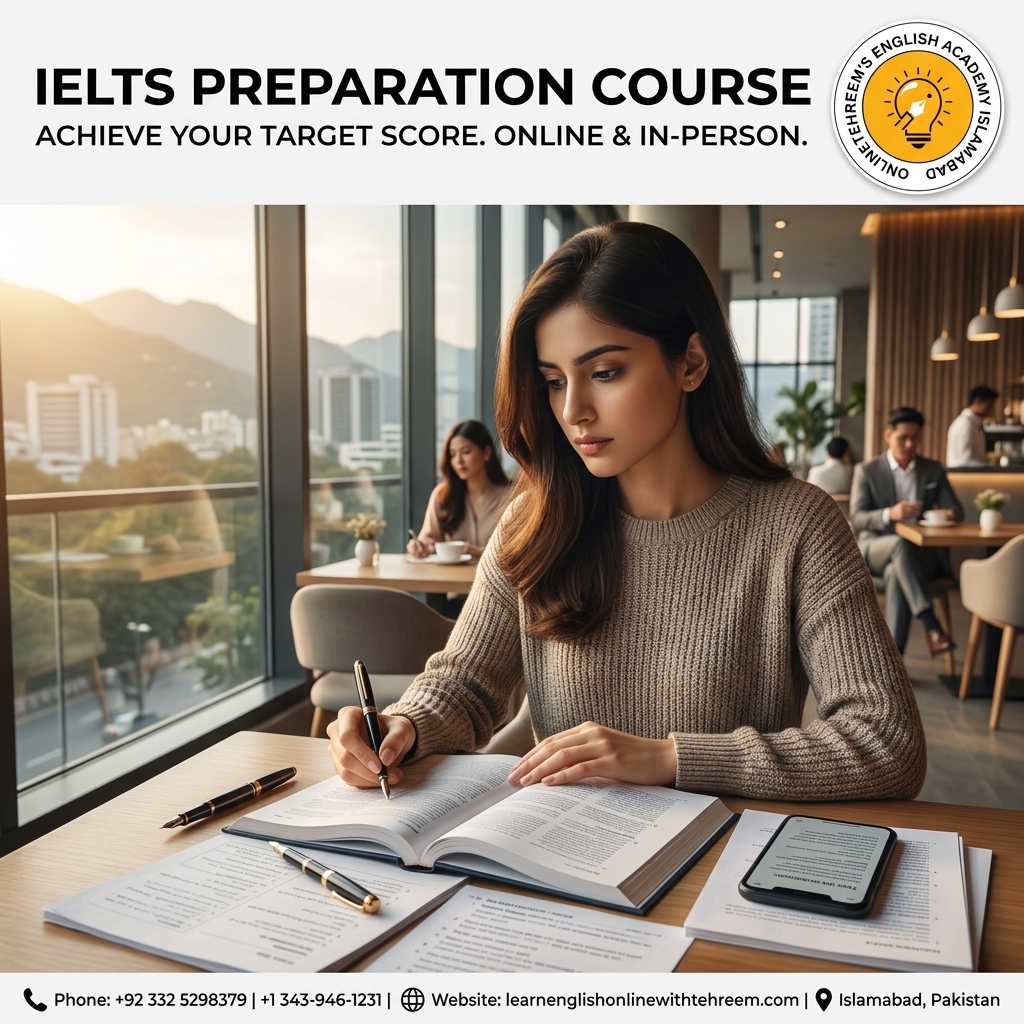
Writing requires careful attention to task requirements, organization, grammar, vocabulary, and clarity.
IELTS Academic Writing
Academic candidates complete two writing tasks. Preparation may include:
- Describing visual information
- Writing essays
- Comparing information
- Identifying key trends
- Developing arguments
- Organizing paragraphs
IELTS General Training Writing
General Training candidates complete a letter-writing task followed by an essay.
Students should learn how to adapt their language according to whether a situation is formal, semi-formal, or informal.
Why Writing Feedback Matters
Writing practice is most useful when someone reviews the work and identifies recurring problems.
Feedback can focus on:
- Task response
- Coherence and cohesion
- Grammar
- Vocabulary
- Sentence structure
- Paragraph organization
Students should keep track of repeated mistakes and practise correcting them.
IELTS Reading Preparation
IELTS Reading requires candidates to understand written information efficiently while managing a strict time limit.
Preparation can include:
- Skimming
- Scanning
- Identifying main ideas
- Locating specific information
- Understanding vocabulary from context
- Recognizing paraphrasing
- Practising different question types
Reading practice should include both accuracy and speed. Simply reading more slowly isn’t always the best solution when time is limited.
IELTS Listening Preparation
The Listening test requires candidates to follow spoken information and identify relevant details.
Students can practise:
- Conversations
- Discussions
- Monologues
- Following instructions
- Identifying specific information
- Recognizing paraphrased language
Regular exposure to spoken English can also improve general listening ability.
Grammar and Vocabulary for IELTS
Grammar and vocabulary contribute to all four IELTS skills.
Grammar
Important areas include:
- Verb tenses
- Articles
- Prepositions
- Subject-verb agreement
- Sentence structure
- Conditionals
- Relative clauses
- Complex sentences
The objective is not to make every sentence complicated. Accurate and appropriate grammar is more valuable than unnecessary complexity.
Vocabulary
Candidates should develop vocabulary through context rather than memorizing isolated word lists.
Useful areas include:
- Academic vocabulary
- Everyday English
- Topic-specific terms
- Collocations
- Synonyms
- Useful expressions
Learners should only use vocabulary they understand and can apply accurately.
The Role of Mock Tests in IELTS Preparation
Mock tests allow candidates to experience timed examination conditions before the actual test.
They can help students:
- Understand the test format
- Practise time management
- Identify weak areas
- Become more comfortable with examination conditions
- Track progress
- Develop a realistic study routine
However, a mock test is most valuable when followed by detailed review.
A useful process is:
Take the test → Check performance → Identify mistakes → Understand why they occurred → Practise the weak area
Common IELTS Preparation Mistakes
Memorizing Speaking Answers
Memorized responses can sound unnatural and may not directly answer the examiner’s question. Flexible speaking practice is generally more useful.
Learning Vocabulary Without Context
Knowing a definition doesn’t necessarily mean you can use a word correctly. Learn vocabulary through sentences and real examples.
Ignoring Writing Feedback
Completing essay after essay without reviewing mistakes can reinforce the same problems.
Practising Only One Skill
IELTS assesses four skills. A balanced preparation plan should include Speaking, Writing, Reading, and Listening.
Ignoring Time Limits
Candidates should gradually introduce timed practice so that completing tasks within the available time becomes familiar.
How to Create an Effective IELTS Study Plan
A simple weekly routine can make preparation more manageable.
| Day | Suggested Focus |
|---|---|
| Monday | Speaking + Vocabulary |
| Tuesday | Reading + Grammar |
| Wednesday | Writing + Vocabulary |
| Thursday | Listening + Speaking |
| Friday | Reading + Writing |
| Saturday | Mock test + Review |
| Sunday | Error correction + Light practice |
The exact schedule should be adjusted according to your current English level and target.
Why Choose Tahreem’s English Academy Islamabad?
Tahreem’s English Academy Islamabad provides structured IELTS training designed to develop both English proficiency and examination skills.
Students can receive support with:
- IELTS Speaking
- IELTS Writing
- IELTS Reading
- IELTS Listening
- Grammar
- Vocabulary
- Pronunciation
- Mock tests
- Time management
- Examination strategies
The focus is on practical learning and consistent improvement. Learners can work on their weaker areas while developing a stronger overall understanding of the IELTS examination.
Frequently Asked Questions
1. What does IELTS Preparation include?
IELTS Preparation generally includes training for Speaking, Writing, Reading, and Listening, together with grammar, vocabulary, pronunciation, test strategies, practice tasks, and mock examinations.
2. How long should I prepare for IELTS?
The appropriate preparation period varies according to your current English level, target score, previous experience, and available study time. A learner with a strong English foundation may need less preparation than someone developing basic language skills.
3. Can beginners start IELTS Preparation?
Yes. Beginners can start with general English development before moving into intensive IELTS-focused practice. Building grammar, vocabulary, pronunciation, and communication skills can provide a stronger foundation.
4. Should I take IELTS Academic or General Training?
It depends on your purpose. Candidates should check the requirements of the university, employer, immigration authority, or other organization they are applying to before selecting the test.
5. How can I improve my IELTS Speaking?
Practise speaking regularly, answer questions spontaneously, develop topic-based vocabulary, work on pronunciation and grammar, and complete mock speaking interviews with useful feedback.
Conclusion
Effective IELTS Preparation combines English-language development with an understanding of the examination format. Candidates need regular practice in Speaking, Writing, Reading, and Listening, along with grammar, vocabulary, pronunciation, time management, and targeted feedback.
At Tahreem’s English Academy Islamabad, learners can follow a structured preparation approach designed around their English skills and IELTS requirements. Whether you’re preparing for IELTS Academic or General Training, consistent practice and careful review of mistakes can help you become a more capable and confident English user while preparing for the examination.